Why Quitters Win by Nick Tasler
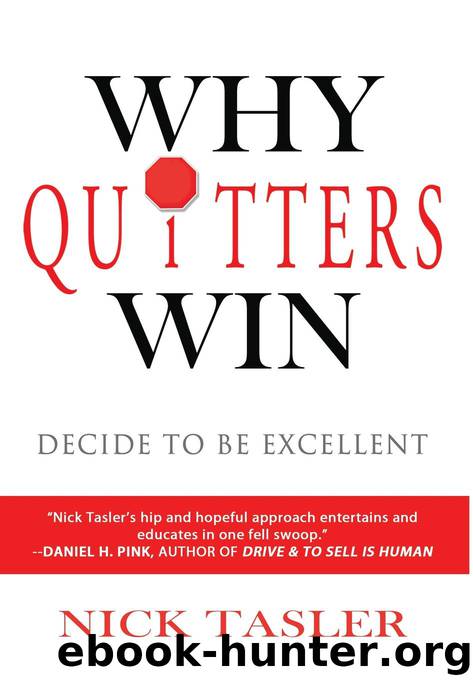
Author:Nick Tasler [Tasler, Nick]
Language: eng
Format: epub
Publisher: Motivational Press, Inc
Published: 2013-09-05T00:00:00+00:00
1. Rebounding Rationality
In the fall of 1939, a bookish 23-year old graduate student at the University of California at Berkeley named Herbert A. Simon took charge of an enormous research project. Together with three of his young colleagues, Simon shed new light on the connection between urban property taxes and municipal revenues in the San Francisco Metropolitan Area. Sensational reading, this study was not. If you cracked open your 1943 issue of the Quarterly Journal of Economics (it’s probably on your coffee table right under that US Weekly) and rated this report for excitement, it would score somewhere between a colonoscopy and a traffic jam.
But buried deep beneath the jargon and complex mathematical formulas in the article titled “Fiscal Aspects of Municipal Consolidation,” Herbert Simon planted the seed of a very important idea. Simon observed that even if city managers were armed with identical information about taxes and revenues, they would often arrive at different conclusions. Each manager would necessarily focus on different pieces of information within the larger whole and reach a different decision than his colleagues. Simon concluded that people’s ability to process information had limits. It was a simple yet revolutionary idea at the time. Whether you realize it or not, this idea significantly altered the trajectory of your life and mine, our society and the global economy. A few years after Fiscal Aspects was released to critical acclaim from upwards of a half-dozen reclusive economists, Simon published another book. In his now classic management text, Administrative Behavior, Simon gave his idea of limited information processing a name. He called it bounded rationality.
Simon argued that people and organizations, in order to function efficiently, must be willing to trade quality for speed when making decisions. Some choices must be made with the understanding that they might not be optimal, but are “good enough.” He called this strategic pursuit of good enough “satisficing.” For Simon, satisficing described what people were already doing (whether they knew it or not) and prescribed what we should be doing in light of our imperfections. In simple terms, Simon was saying, “Sure, it would be great if we all had the time and processing power to analyze all the data before us. But, c’mon folks, let’s be realistic. You don’t have that kind of time or brain power. Pick your battles and start satisficing.”
According to the Nobel Committee in 1978, Simon was right. Around that same time, a burgeoning field of research — known by its street name, “behavioral economics” — picked up Simon’s torch and proved just how bounded our rationality is. In experiment after experiment, behavioral economists showed that the everyday person’s rationality was bounded, if not crippled, by scores of predictable biases and errors in judgment. Today, behavioral economists have pretty well shredded the age-old doctrine of the Efficient Markets Hypothesis which said that people always behave rationally, and that a collection of those rational people all making bets in the same marketplace will create an infallibly efficient system (pay no attention to the men behind the bubbles).
Download
This site does not store any files on its server. We only index and link to content provided by other sites. Please contact the content providers to delete copyright contents if any and email us, we'll remove relevant links or contents immediately.
Tools of Titans by Timothy Ferriss(8396)
Change Your Questions, Change Your Life by Marilee Adams(7783)
Deep Work by Cal Newport(7085)
Playing to Win_ How Strategy Really Works by A.G. Lafley & Roger L. Martin(6308)
Man-made Catastrophes and Risk Information Concealment by Dmitry Chernov & Didier Sornette(6019)
Big Magic: Creative Living Beyond Fear by Elizabeth Gilbert(5773)
Digital Minimalism by Cal Newport;(5765)
Ego Is the Enemy by Ryan Holiday(5450)
The Slight Edge by Jeff Olson(5418)
The Motivation Myth by Jeff Haden(5213)
The Laws of Human Nature by Robert Greene(5208)
Stone's Rules by Roger Stone(5088)
Tuesdays with Morrie by Mitch Albom(4784)
Eat That Frog! by Brian Tracy(4540)
Rising Strong by Brene Brown(4463)
Skin in the Game by Nassim Nicholas Taleb(4250)
The Money Culture by Michael Lewis(4207)
Bullshit Jobs by David Graeber(4191)
Skin in the Game: Hidden Asymmetries in Daily Life by Nassim Nicholas Taleb(4007)
